What is a harmonic minor scale?
The harmonic minor scale is a variation of the natural minor scale that features a raised seventh degree. It is often used in classical, jazz, and other genres to create a distinct sound and add tension to melodies and harmonies. The formula for the harmonic minor scale is as follows:
1 – 2 – ♭3 – 4 – 5 – ♭6 – 7 – 1
For example, in the key of A minor, the notes of the A harmonic minor scale would be:
A – B – C – D – E – F – G♯ – A
Compared to the natural minor scale, the harmonic minor scale has a raised seventh (7) degree, indicated by the G♯ in the example above. This alteration creates a unique interval of an augmented second between the sixth and seventh degrees, which contributes to its distinctive sound.
The harmonic minor scale is particularly useful for creating dominant seventh chords and establishing a dominant-tonic relationship. In classical music, it is often employed in melodic and harmonic minor key passages, and it is also frequently used in jazz improvisation, giving musicians more options for melodic variation and harmonic tension.
What is a natural minor scale?
The natural minor scale, also known as the Aeolian mode, is a diatonic scale that is derived from the major scale. It is a seven-note scale that follows a specific pattern of whole steps (W) and half steps (H). The formula for the natural minor scale is as follows:
1 – 2 – ♭3 – 4 – 5 – ♭6 – ♭7 – 1
For example, in the key of A minor, the notes of the A natural minor scale would be:
A – B – C – D – E – F – G – A
Compared to the major scale, the natural minor scale has a flattened third (♭3), sixth (♭6), and seventh (♭7) degrees. This alteration gives the scale a distinct minor tonality and a melancholic or somber sound.
The natural minor scale is commonly used in various styles of music, including classical, jazz, rock, and pop. It serves as the foundation for melodies, harmonies, and chord progressions in minor keys.
What is a minor blues scale?
The minor blues scale is a musical scale that is commonly used in blues, jazz, and rock music. It is derived from the natural minor scale with the addition of a lowered fifth (also known as the “blue note”). The formula for the minor blues scale is as follows:
1 – ♭3 – 4 – ♭5 – 5 – ♭7 – 1
For example, in the key of A minor, the notes of the A minor blues scale would be:
A – C – D – D♯/E♭ – E – G – A
The lowered fifth (♭5) or the “blue note” is one of the defining characteristics of the blues sound. It adds a distinctive bluesy and melancholic quality to the scale. The minor blues scale is often used in improvisation and soloing over blues chord progressions, and it can create a moody and expressive atmosphere in music.
What is a major blues scale?
The major blues scale is a musical scale that combines elements of both the major scale and the blues scale. It is often used in blues, rock, jazz, and other genres to create a distinctively bluesy sound with a major tonality. The major blues scale is built upon the major pentatonic scale, with the addition of one “blue” note.
To understand the major blues scale, let’s consider it in the key of C. The major blues scale in C consists of the following notes: C, D, E♭, E, G, and A.
The pattern of intervals in the major blues scale is as follows:
Root (C) – whole step to D – half step to E♭- half step to E – 1 1/2 step to G – whole step to A – 1 1/2 step to C.
So, the major blues scale in C would be: C, D, E♭, E, G, A, C.
The added “blue” note in the major blues scale is the flattened third (E♭ in the key of C). This note, along with the other notes of the major pentatonic scale (C, D, E, G, A), contributes to the characteristic bluesy sound.
The major blues scale offers a brighter and more uplifting tonality compared to the minor blues scale, which is rooted in the minor pentatonic scale and has a darker, more melancholic quality. The major blues scale is often employed in blues improvisation and soloing, allowing musicians to incorporate both major and bluesy elements into their playing.
It’s worth noting that the major blues scale can be transposed to any key by applying the same pattern of intervals to the desired root note. This flexibility allows musicians to use the major blues scale in different musical contexts and keys, adding a touch of bluesy flavor to their compositions and improvisations.
What is a diatonic major scale?
A diatonic major scale is a seven-note musical scale that follows a specific pattern of whole steps (W) and half steps (H). It is a fundamental scale in Western music and forms the basis for constructing major keys.
The pattern for a diatonic major scale is as follows:
W – W – H – W – W – W – H
To illustrate this pattern, let’s take the C major scale as an example:
C – D – E – F – G – A – B – C
In this scale, you can see that the intervals between the notes follow the pattern of whole steps (W) and half steps (H). For example, the interval between C and D is a whole step (W), between D and E is a whole step (W), between E and F is a half step (H), and so on.
It’s important to note that the diatonic major scale always follows this pattern, regardless of the starting note. By applying the same pattern starting from any other note, you can construct the major scale in different keys.
The diatonic major scale is widely used in Western music and forms the basis for melodies, harmonies, chords, and key signatures. It has a bright and uplifting sound and is often associated with happy or joyful music.
What is a chromatic scale?
The chromatic scale is a musical scale consisting of 12 pitches, each a half step or semitone apart from the next. It includes all the notes in Western music, both those used in major and minor scales and those that fall “in between” the whole steps of those scales. The 12 pitches of the chromatic scale can be represented by the natural notes (A, B, C, D, E, F, G) and the accidentals (sharp # and flat b).
Here is an example of the chromatic scale starting from the note C:
C – C#/Db – D – D#/Eb – E – F – F#/Gb – G – G#/Ab – A – A#/Bb – B – C
In this sequence, each note is a half step away from the next note. The chromatic scale can be played on various instruments and is often used to create tension, transition between keys, or explore dissonant or atonal music.
Chords Level 1 and a Quiz
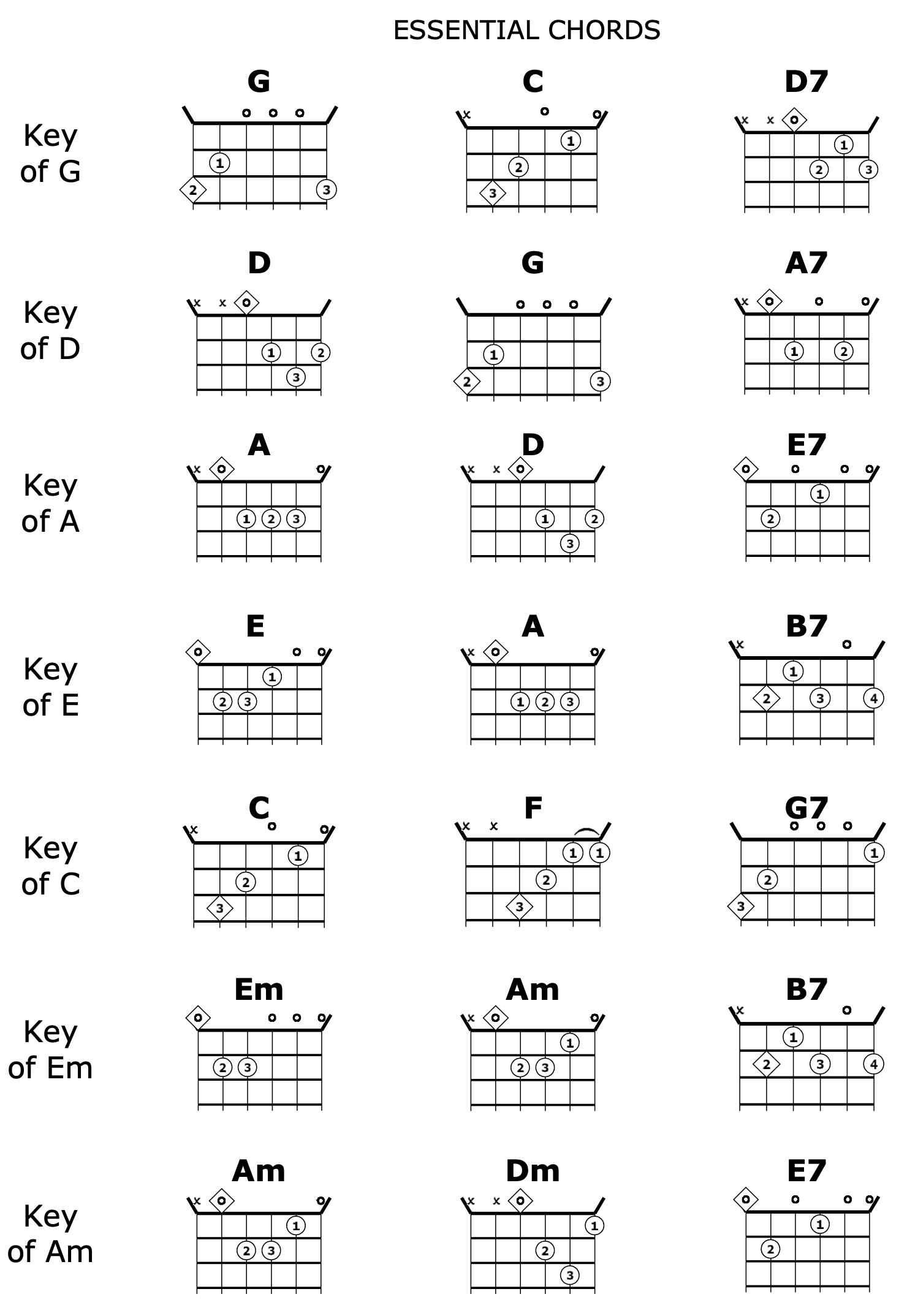
In chords level 1 there are 7 keys with each key containing 3 chords. I refer to these chords as ‘guitar friendly’ chords because there are no barre chords (harder chords) involved.
- Memorize all of the chords and be able to change chords quick. You will not be satisfied with your playing until you can change chords quickly. Find some easy song that use the chords to make it more fun.
- Know what 3 chords are in each key.
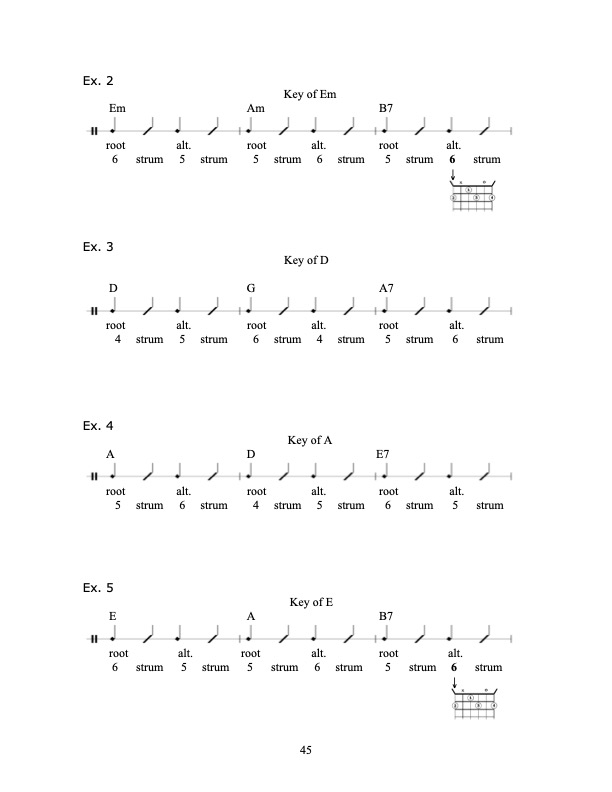
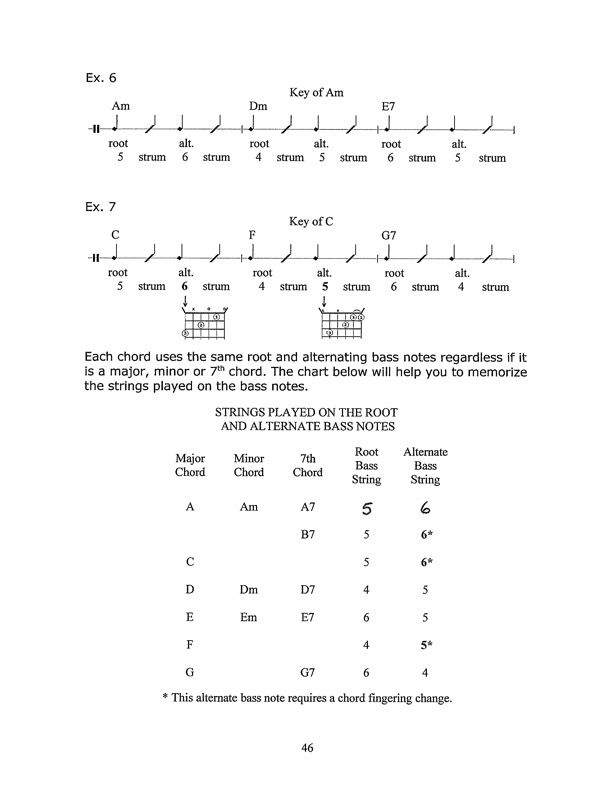
3. Know the root notes (1st interval) and the alternate bass notes (5th interval) of all chords:

Quiz:
What are the 3 basic chords in the following keys (The I, IV, V chord progression)?
- G:
- Em:
- D:
- A:
- E:
- Am:
- C:
What strings do you pluck to get the bass (root) and alternate bass (5th interval) notes when playing the boom chick rhythm on the following chords? A hint: It’s never string 1, 2, or 3.
- G
- C
- D7
- Em
- Am
- B7
- D
- G
- A7
- A
- E7
- E
- Dm
- F
- G7
What is the main purpose of a capo?
We need to score 100 before proceeding to level 2.
Practice! Practice! Practice!
Trail Of Woe
This Thanksgiving I especially have reason to give thanks to God.
There are few times in one’s life when a summer evening bike ride turns into an endurance test that is not only potentially life threatening but becomes a lifelong memory. I recently had such an evening bike ride. This is my story.