Slack Key Tuning
Slack Key tuning refers to a variety of open tunings used in Hawaiian Slack Key Guitar (Ki Ho’alu), a fingerstyle genre of guitar music that originated in Hawaii in the early 19th century. The term “slack key” comes from the practice of “slacking” the strings, meaning to loosen or detune them, to create open chords. This allows the guitar to be played with a more resonant and full sound, as strumming the open strings forms a chord.
There are many different slack key tunings, each with its unique sound and mood. These tunings often have a major chord when played open, but variations exist to create different harmonies. The tunings are often named after the family or region from which they originated, and they are a significant part of the musical and cultural tradition of Hawaii.
A few common Slack Key tunings include:
- Taro Patch Tuning (Open G Tuning): D-G-D-G-B-D from low to high. This is one of the most common slack key tunings, providing a G major chord when played open.
- Wahine Tunings: These tunings typically have a major 7th note in the bass, creating a sweet and melodic sound. An example is the C Wahine Tuning: C-G-D-G-B-E.
- Mauna Loa Tunings: Named after the volcano on the Big Island of Hawaii, these tunings often feature a bass string tuned to a note that creates a deep and resonant sound. An example is B-G-D-G-B-D.
- Drop Tunings: Similar to the drop D tuning in non-Hawaiian music but applied to other notes, such as Drop C (C-G-C-G-B-E) or Drop G (G-G-D-G-B-D).
Each slack key tuning creates a different ambient sound and allows for unique melodic and harmonic possibilities. Guitarists playing in this style often use fingerpicking techniques to play the melody and accompaniment simultaneously, often incorporating the characteristic slurs and slides that give slack key guitar its distinctive, laid-back sound.
Slack Key Guitar is deeply rooted in Hawaiian culture, embodying the spirit of aloha and the islands’ natural beauty. It’s traditionally played solo, but it can also accompany singing and hula dancing.
Open C Tuning
Open C tuning is a method of tuning a guitar in which the strings are tuned to the notes of a C major chord. This tuning allows guitarists to play a C major chord without having to fret any of the strings, hence the name “open” tuning. The notes for open C tuning, starting from the lowest (6th) string to the highest (1st) string, are typically C, G, C, G, C, E. This tuning configuration can produce a very rich and resonant sound, making it popular for certain styles of music, such as folk, blues, and slide guitar playing. The specific tuning sequence is:
- The 6th string (E) is tuned down two whole steps to C.
- The 5th string (A) is tuned down one whole step to G.
- The 4th string (D) remains the same, tuned to C (one step down from standard tuning).
- The 3rd string (G) remains the same.
- The 2nd string (B) is tuned up one half step to C.
- The 1st string (E) remains the same.
Open C tuning lends itself well to a variety of musical genres and has been used in many songs across rock, folk, and alternative music.
Friends is an example of open C tuning. Let me know if you know other songs in open C?
Vestapol Tuning
Vestapol tuning, often referred to in the context of “Open D” tuning, is a type of open tuning used on the guitar. The term “Vestapol” historically refers to a family of open tunings that originated from a piece called “The Siege of Sevastopol” but has commonly come to be associated with open D and open E tunings. The naming convention comes from a misspelling or corruption of “Sevastopol.” Over time, “Vestapol” tuning became a generic term for certain open tunings.
Open D tuning specifically refers to tuning the guitar so that when you strum the open strings, they form a D major chord. The notes from the lowest string to the highest in Open D tuning are:
- D (the sixth string is tuned down from E to D)
- A (the fifth string remains unchanged)
- D (the fourth string remains unchanged)
- F# (the third string is tuned up from G to F#)
- A (the second string is tuned down from B to A)
- D (the first string is tuned down from E to D)
This tuning is popular among slide guitarists, fingerstyle players, and blues musicians because it allows for easy formation of major chords with a slide or by barring the fingers across the strings. It also provides a rich, resonant sound that’s very different from standard tuning, offering a new palette of harmonic possibilities and textures for guitarists to explore.
Open D tuning is used in various musical genres, from folk and blues to rock and beyond. It’s particularly favored for its deep, drone-like qualities and the ease with which it allows guitarists to play in the key of D major, providing a lush and full sound that’s ideal for both rhythm and solo playing.
Spanish Tuning (open G or A)
Spanish tuning is a type of open tuning used on the guitar, commonly referred to as Open G tuning. It’s called “Spanish tuning” because of its association with traditional Spanish guitar music, although it’s widely used in various music genres, especially blues, folk, and rock. The term can sometimes cause confusion, as “Spanish tuning” might also be loosely used to refer to the standard tuning of classical and flamenco guitars, which is the same as the standard tuning for most guitars (E A D G B E). However, when specifically talking about open tunings, Spanish tuning typically refers to Open G.
In Spanish tuning (Open G), the guitar is tuned to a G major chord when strumming the open strings, hence the term “open tuning.” The specific notes from low to high are:
- D (the sixth string is tuned down a whole step from E to D)
- G (the fifth string remains unchanged)
- D (the fourth string remains unchanged)
- G (the third string remains unchanged)
- B (the second string remains unchanged)
- D (the first string is tuned down a whole step from E to D)
This tuning allows guitarists to play a G major chord without fretting any strings, hence the name “open” tuning. It also facilitates playing chord shapes and slide guitar, making it a popular choice for blues and slide guitarists. The tuning emphasizes the resonant and rich sound of the guitar, allowing for a wide range of expressive and dynamic playing.
Famous guitarists like Robert Johnson, Keith Richards of The Rolling Stones, and Ry Cooder have used Spanish tuning (Open G) to create some of their most iconic music. Keith Richards, in particular, is known for his extensive use of this tuning in creating the distinctive riffs that define many of The Rolling Stones’ biggest hits.
DADGAD Tuning
DADGAD tuning is an alternative guitar tuning that deviates from the standard EADGBE tuning to DADGAD, from the lowest string to the highest. This tuning lowers the pitch of the sixth, second, and first strings by a whole step (two frets) from standard tuning, resulting in an open Dsus4 chord when the guitar is strummed open, without fretting any notes.
Here’s a breakdown of its characteristics and benefits:
1. Open Tuning:
- DADGAD is considered an open tuning because strumming the open strings produces a chord. This particular tuning gives an open Dsus4 chord, which can add a drone-like quality to the music. This droning effect is characteristic of many traditional and folk music styles, making DADGAD popular among folk, Celtic, and fingerstyle guitarists.
2. Simplified Chord Shapes:
- Many chord shapes become simpler in DADGAD tuning, allowing for easy transitions and unique voicings. This can be particularly beneficial for fingerstyle playing, where the guitarist may want to incorporate complex melodies and bass lines simultaneously.
3. Creative and Sonic Exploration:
- The altered string relationships in DADGAD invite creative exploration, leading to innovative chord progressions, melodies, and textures that might not be as intuitive in standard tuning. It’s especially conducive to modal playing, where the guitarist can explore different musical modes easily by moving familiar shapes up and down the fretboard.
4. Enhanced Harmonics:
- DADGAD tuning can produce rich and resonant harmonics, partly due to the sympathetic vibration of open strings that are in tune with fretted notes. This can add a lush, ambient quality to the music, which is especially appealing in solo acoustic performances.
How to Tune to DADGAD:
- Start in Standard Tuning (EADGBE).
- Lower the Sixth String: Lower the pitch of the sixth string from E down to D.
- Lower the Second String: Adjust the pitch of the second string from B down to A.
- Lower the First String: Tune the first string down from E to D.
- Fine-tune: Ensure all strings are accurately tuned to DADGAD. An electronic tuner is very helpful for achieving precise tuning.
Applications:
DADGAD tuning has been widely used in a variety of musical genres beyond its folk roots, including rock, blues, and even classical music. Its versatility and the distinct sonic landscapes it offers make it a favorite among many guitarists looking to expand their musical palette.
The tuning’s popularity is partly due to its ability to blend simplicity and complexity, making it accessible to beginners while still offering depth and creative possibilities for advanced players. Whether used for rhythm playing, intricate fingerstyle arrangements, or solo compositions, DADGAD tuning provides a rich foundation for musical exploration.
Here is one of my originals I did in DADGAD:
Kashmir by Led Zepplin was also done in DADGAD tuning:
Double Drop D Tuning
Double Drop D tuning is an alternative tuning for the guitar that modifies the standard tuning by lowering both the sixth (the thickest string) and the first (the thinnest string) strings down a whole step from E to D. This results in a tuning of DADGBD, from the sixth string to the first.
This tuning shares some similarities with Drop D tuning (DADGBE) but goes further by also tuning down the first string, which adds a symmetrical aspect to the tuning and offers several unique benefits:
1. Extended Range:
- Like Drop D, Double Drop D extends the guitar’s range on the lower end, but it also adds depth to the higher register by lowering the first string. This can create a fuller, more resonant sound that is particularly effective for solo acoustic performances, where the guitar must fill a lot of sonic space.
2. New Chord Voicings:
- The tuning allows for new chord voicings and textures that are not possible in standard tuning. It facilitates open, droning sounds that can give a song an ethereal or majestic quality. The symmetrical tuning of the two outer strings to D can make certain fingerings easier and inspire new approaches to chord progressions and melodies.
3. Ease of Playing:
- Similar to Drop D, Double Drop D can simplify the fingerings for certain chords and riffs. For example, a D chord can be played by strumming all strings open, creating a powerful and resonant D5 chord that utilizes the guitar’s entire range.
4. Creative Inspiration:
- This tuning can inspire new ideas for songwriting and arrangements. The altered intervals and the ability to use open strings in new ways can lead to innovative guitar parts that might not be as intuitive in standard tuning.
How to Tune to Double Drop D:
- Start in Standard Tuning (EADGBE).
- Lower the Sixth String: Use an electronic tuner to accurately lower the pitch of the sixth string from E down to D.
- Lower the First String: Similarly, adjust the first string down from E to D. You can compare it to the fourth string (D) to help ensure it’s in tune, remembering it should be two octaves higher than the sixth string.
- Fine-tune: Check and adjust all strings as necessary to ensure they are in tune.
Double Drop D tuning is especially popular in folk, rock, and solo acoustic guitar music for its rich harmonic possibilities and the ease with which it allows the guitarist to create a full and vibrant sound. It’s a favorite among songwriters and fingerstyle players for the unique tonal qualities and the creative avenues it opens up.
Here is a couple of examples using double drop D tuning:
Drop D Tuning
Drop D tuning is a popular alternative tuning for the guitar, particularly common in rock, metal, and acoustic genres. It involves lowering the pitch of the sixth string (the thickest string) from E down to D, while leaving the other five strings in their standard tuning (EADGBE). Thus, the tuning for the strings from the sixth to the first becomes DADGBE.
Here’s a breakdown of how Drop D tuning changes the way a guitar is played and its benefits:
1. Easier Power Chords:
- In Drop D, power chords (which are a fundamental element in rock and metal music) can be played with a single finger across the lowest three strings. This simplifies the fretting hand technique and allows for faster chord changes and a heavier, more resonant sound due to the lower pitch of the sixth string.
2. Extended Lower Range:
- Dropping the pitch of the sixth string adds a lower note to the guitar’s range. This can be particularly effective for creating deeper, more powerful bass lines or riffs that wouldn’t be possible in standard tuning.
3. Creative Possibilities:
- The change in tuning can inspire new songwriting ideas and riffs. The altered intervals between the strings can lead to discovering new chord voicings and melodic lines that aren’t as intuitive in standard tuning.
4. Transition Between Tunings:
- It’s relatively quick and easy to switch between standard tuning and Drop D, as it only involves changing the pitch of one string. This makes it a practical option for live performances where a variety of songs may require different tunings.
How to Tune to Drop D:
- Start in Standard Tuning (EADGBE).
- Use a Tuner: It’s recommended to use an electronic tuner for accuracy.
- Lower the Sixth String: Turn the tuning peg for the sixth string to lower the pitch from E down to D. You can check this against the fourth string (which is also a D, but an octave higher) to ensure it’s correctly tuned.
- Fine-tune: Make minor adjustments if necessary to ensure all strings are in tune.
Drop D tuning allows for a blend of heavy, impactful riffs with the versatility of being able to play standard chords and melodies on the higher strings, making it a favorite among many guitarists across various genres.
This is one of my originals I did in drop D:
Dear Prudence from The Beatles White album is another example of Drop D Tuning:
Harmonized Scales
Harmonized scales, when explained using traditional music theory terms, refer to the process of building chords using the notes of a scale in a systematic way, such that each note of the scale becomes the root of a chord. This creates a series of chords that are harmonically related to the scale and to each other. The harmonized scale forms the foundation for chord progressions within a key, contributing to the harmonic structure of a piece of music. Here’s a more detailed explanation using traditional terms:
- Scale: A sequence of notes ordered by pitch, such as the major scale or the minor scale. Each scale is defined by a unique pattern of whole steps (tones) and half steps (semitones).
- Triad: The simplest type of chord, consisting of three notes: the root, the third, and the fifth. Triads can be major, minor, diminished, or augmented, depending on the intervals between the notes.
- Harmonizing a Scale: To harmonize a scale means to build triads (or more complex chords) on each degree (note) of the scale. This is done by stacking thirds from the scale: you start with a scale note, skip the next scale note, add the next one, skip another, and add the next. This pattern creates a triad.
- Degrees of the Scale: Each note in a scale is assigned a degree, numbered from 1 to 7 (in a seven-note scale like the major or minor scale). These degrees are also given Roman numerals, which help to denote the chord built on that degree and its quality (major, minor, diminished).
- Harmonized Major Scale Example: In the key of C major, the scale is C-D-E-F-G-A-B. Harmonizing each note using triads gives us:
- I: C major (C-E-G)
- ii: D minor (D-F-A)
- iii: E minor (E-G-B)
- IV: F major (F-A-C)
- V: G major (G-B-D)
- vi: A minor (A-C-E)
- vii°: B diminished (B-D-F)
Harmonizing scales is a fundamental aspect of traditional Western music theory, providing a systematic approach to creating chord progressions that are coherent and musically satisfying within a given key.
In this exercise we see the C major scale on the first line. The second line is harmony in thirds and the bottom line illustrates the harmonized scale in the key of C.
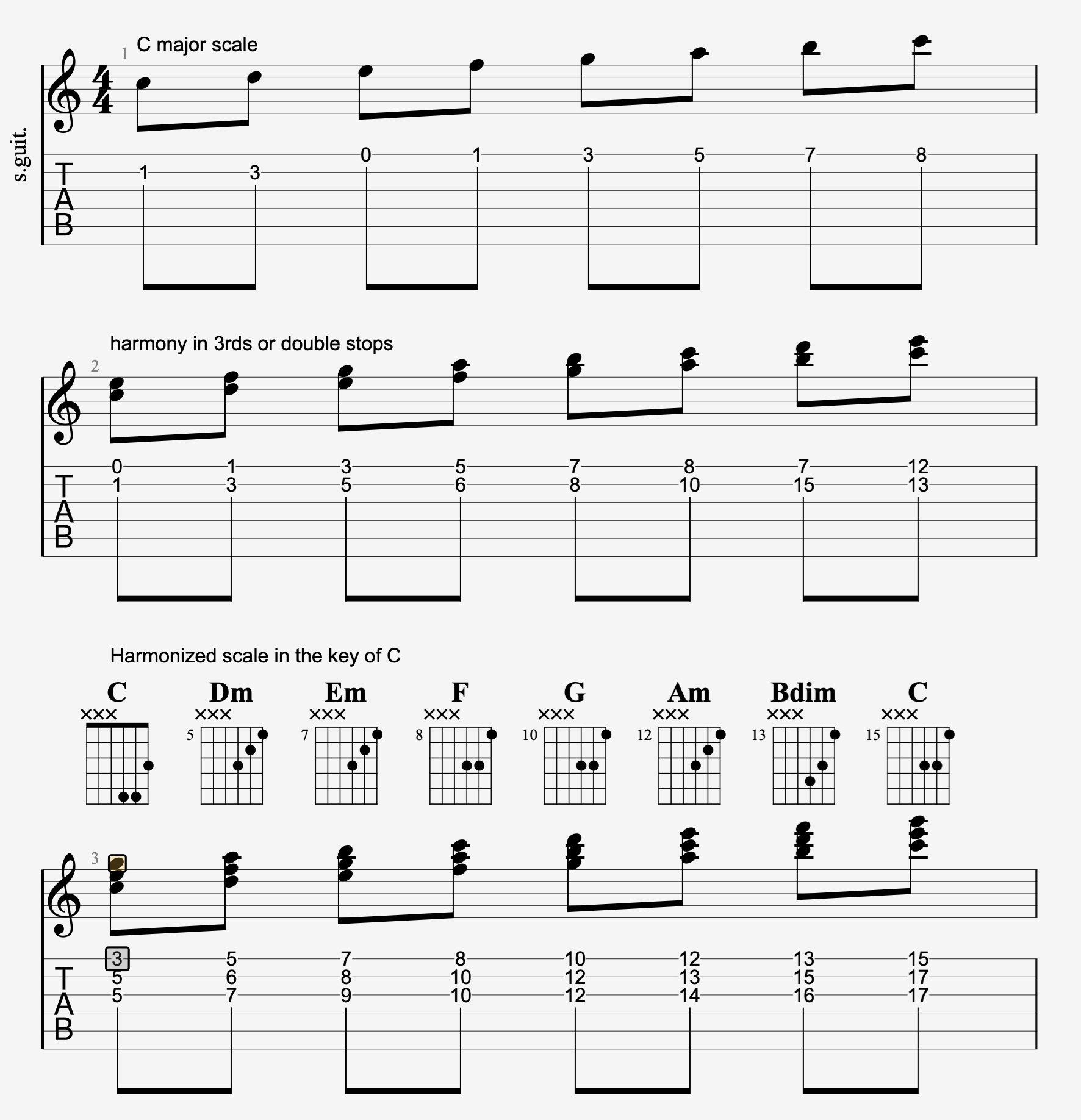
Below we have various ways to play the harmonized scales as we discussed in the previous lessons on triads.
Root position triads


 First Inversions


 Second inversions


Triads Review
Root position triads
First Inversions Second inversions